Eskişehir Chamber of Industry takes a leading role in compliance with the European Green Deal
Ezgi Elif Şahin

The European Green Deal, launched by the European Union with the goal of becoming the world’s first climate-neutral continent by 2050, calls not only on European countries but also on all global trade actors to undergo a comprehensive transformation. The deal foresees radical changes in many sectors, including cement, iron and steel, aluminum, fertilizer, hydrogen, and electricity. The Carbon Border Adjustment Mechanism (CBAM), which aims to reduce greenhouse gas emissions by at least 55% by 2030 compared to 1990 levels and to achieve net-zero emissions by 2050, directly affects Turkey.
Although there are some support mechanisms in Turkey for green transformation investments, these systems remain insufficient in terms of scale, impact, and accessibility. In particular, there is a need for more comprehensive, sector-specific, and sustainable financing models for investments in carbon footprint reduction, energy efficiency, waste recovery, renewable energy, and green innovation.
One-third of greenhouse gas emissions come from industry
Dr. Çağdaş Saz, working at the Sustainable Green Industry Unit (SGIU) within the Eskişehir Chamber of Industry, evaluated Turkey’s industry-focused green transformation process in our interview. Saz emphasized that significant steps have been taken in the industrial field in line with the United Nations Sustainable Development Goals (SDGs), which Turkey adopted in 2015.
Stating that the industrial sector lies at the heart of this transformation, Saz noted that approximately one-third of Turkey’s total greenhouse gas emissions originate from industry. He added that the implementation of SDGs, especially those related to “climate action,” “responsible consumption and production,” and “industry, innovation, and infrastructure,” cannot be achieved without the participation of industrial enterprises.
Saz pointed out that the sectors to be initially affected under CBAM include carbon-intensive industries such as cement, iron and steel, aluminum, fertilizer, hydrogen, and electricity. He stressed that accurate calculation, reporting, and reduction of emissions are essential for both the success of the plan and the sustainability of trade with the EU.
SMEs are the most vulnerable group in the transformation
The green transformation brings about not only environmental but also social change. Small and medium-sized enterprises (SMEs) are among the most affected groups in this process.
SMEs make up approximately 99% of all businesses in Turkey. These enterprises play a critical role in production and employment and are central in supply chains. In industrialized cities such as Eskişehir, SMEs operate as direct suppliers to large industrial firms in sectors such as automotive, machinery manufacturing, chemicals, and white goods.
Therefore, SMEs working with large firms need to comply with the environmental standards and regulations introduced by the European Union. Especially SMEs trading with the EU or producing in accordance with EU standards are directly affected by regulations such as CBAM. The obligation for large firms to select suppliers based on environmental criteria in export processes requires SMEs to adapt rapidly to this transformation.
SMEs receive support from ECI
The Sustainable Green Industry Unit operating under the Eskişehir Chamber of Industry provides multi-faceted technical support to SMEs. Companies can receive professional assistance in areas such as carbon footprint calculation, development of emission reduction strategies, preparation of CBAM-compliant product documentation, sustainability reporting, and project-based improvement plans.
The technical consultancy process consists of analysis, calculation, implementation, and reporting stages. It is carried out by Prof. Dr. Cengiz Türe and Dr. Çağdaş Saz. Additionally, ECI Assembly Member and Chairman of the Board of Benli Recycling, as well as ECI Deputy Secretary General İsmail Öztürk, also contribute to ensuring sustainability in industry.
The unit creates a carbon inventory based on operational data specific to each SME. Carbon reduction scenarios are developed in line with this data, and the process is managed together with the firm.
Corporate carbon footprint calculations in accordance with ISO 14064-1:2018 standards, product-based embedded carbon analyses for exports, and CBAM technical files based on these calculations are prepared by ECI SGIU.
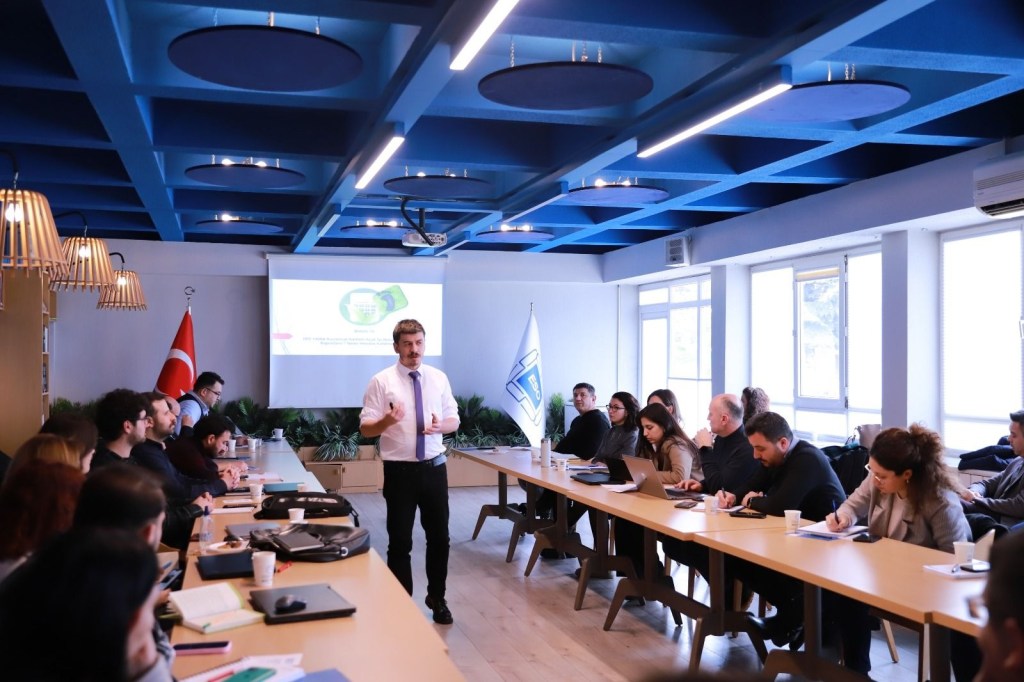
26 SMEs received support in 2025
ECI works not only locally but also in coordination with central government institutions such as the Ministry of Environment, Urbanization and Climate Change, the Ministry of Trade, and the Ministry of Industry and Technology. In this way, the views of industrialists are directly reflected in policy-making processes.
To date, 23 projects have been successfully completed under TÜBİTAK’s 1831 Green Innovation Technology Mentorship Program, with a total of 4 million 750 thousand Turkish lira in grant support provided. Additionally, as of 2025, three different SMEs have received a total of 22,000 euros in support through the EU-funded SeeBridge Program.
ECI supports industry in the green transformation
The main goal of the green transformation is not only for industrial enterprises to comply with legal obligations, but also to gain a competitive advantage, access new markets, and strengthen institutional sustainability.
Such regional initiatives carried out in industrially dense cities like Eskişehir are considered a driving force in Turkey’s progress toward achieving the Sustainable Development Goals.

 Eskısehir ın Europe