Europe’s doors are open to everyone with Erasmus+ and youth funds
Begüm Bedir
Going to Europe, taking part in international projects, and producing solutions to social problems are attracting increasingly more attention among young people in Turkey. However, when “Erasmus” is mentioned, the vast majority of society only thinks of the student mobility that university students participate in. But is this really all there is to it? Who are European Union funds open to, how are projects written, and can a young person who does not attend university benefit from these funds?
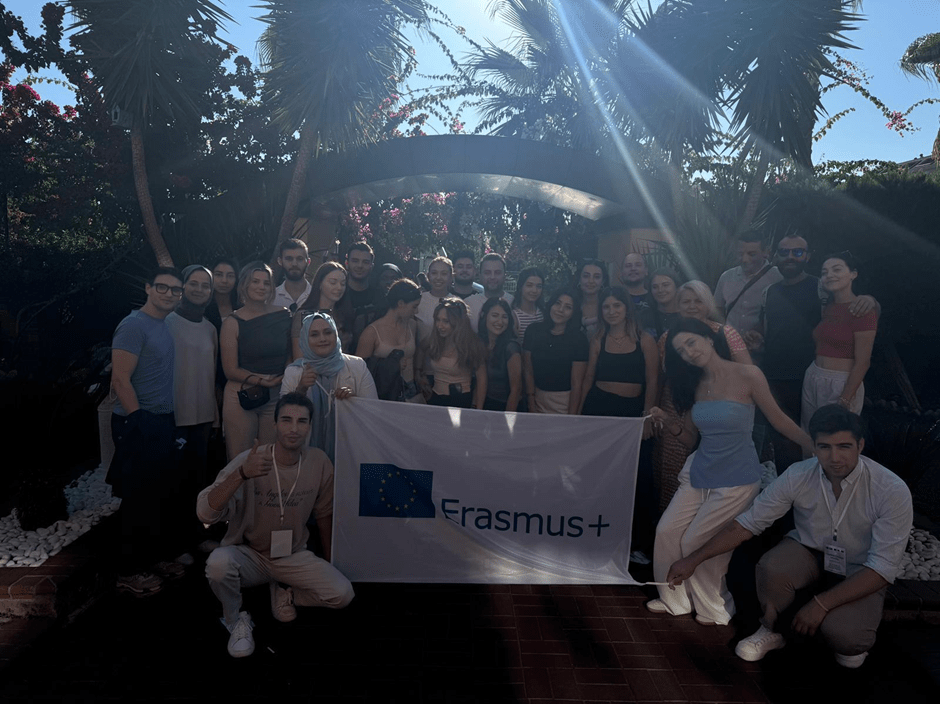
As Eskişehir in Europe, we tackled this issue with two experienced young experts in the kitchen of EU projects, Muhammed Furkan Çelik and Mahmut Talha Serenli, to open the doors of this massive universe of opportunities.
24-year-old Muhammed Furkan Çelik is a senior student in the Social Work Undergraduate Program at Hacettepe University. Stating that his introduction to this field was during the 2022 European Youth Year, Çelik expresses how his own prejudices were broken by saying, “Up until that moment, I too thought that Erasmus+ consisted solely of student mobility at the university, just like everyone else.” Currently, he actively writes projects, acts as an organizer, and participates in various projects across the EU in a partner role.
25-year-old Mahmut Talha Serenli is a senior student in International Relations at Ankara Hacı Bayram Veli University. Serenli, who has been working in the digital communication and civil society sector for about five years, summarizes how he got involved in the process with these words: “I especially take on roles as a project writer, coordinator, and visibility/dissemination expert in European Union- and Ministry-supported projects.” He continues to establish international partnerships by writing his own EU projects in areas such as youth rights, digital threats, and disaster policies.
What are the projects other than student mobility?
The perception in society that “Erasmus equals university student” is one of the biggest myths trying to be destroyed in the field. Drawing attention to this misconception, Mahmut Talha Serenli says, “When Erasmus is mentioned, everyone thinks of the six-month ‘Student Mobility’ conducted through the international offices of universities, which requires a grade point average and a language exam.” However, he points out that the program is a massive umbrella covering the fields of education, youth, and sports.
Serenli details the “Youth Projects” where a university requirement is not sought as follows: “In the mobilities we call Youth Exchanges, young people from different countries come together around a common topic, such as the climate crisis or human rights, for between five and twenty-one days. Anyone between the ages of 13 to 30 can apply to these projects; whether they are a student, working, or unemployed makes absolutely no difference.” He also emphasizes that in the European Solidarity Corps (ESC), which encompasses social responsibility projects, young people can work as full-time volunteers in Europe in many areas ranging from the education of disadvantaged children to environmental cleanup.
Furkan Çelik also supports this idea, stating that the Erasmus+ program is a much deeper and multi-layered universe of opportunities. Çelik defines the program with the words, “It transforms into a massive school of life that appeals not only to students but to every segment of society.”
The project writing process as if explaining to a 5-year-old
To concretize the seemingly complex project writing process, Mahmut Talha Serenli uses a very striking “playground” metaphor. Serenli summarizes the process as follows: “There is no playground in your neighborhood, and you are very bored with your friends. In project language, we call this a ‘Needs Analysis.’ You dream, ‘If only we had a wonderful park with a slide and a swing!’, and this becomes our ‘Project Aim’.” Later, he explains that international partnerships are established by calling children from other neighborhoods, planning who will do what is the budget process, and finally taking this drawing to the European Union, namely the headman of the neighborhood, to ask for pocket money.
Regarding how to apply, Furkan Çelik states that the process is carried out entirely over digital platforms. Çelik says, “First, we register in the system by getting an OID number for our institution or group, and then we upload the project we prepared to the system until the specified application deadlines.” He also underlines that a massive institution is not needed to apply, and at least five young people can come together and apply.
Can a young person who does not attend university benefit from EU funds?
Both experts give a very clear and hopeful “Yes!” answer to this question. Emphasizing that this situation lies at the very heart of the program’s “inclusivity” principle, Furkan Çelik says, “The European Union goes after the one who has an ‘idea and enthusiasm’ rather than academic titles. Not attending university is not an obstacle; on the contrary, due to the program’s principle of ‘inclusivity’… it is always a priority criterion.” Çelik states that an 18-year-old youth can gather at least four more friends alongside himself/herself to establish an “Informal Youth Group” and apply for a grant directly.
Mahmut Talha Serenli, on the other hand, points out that there is a special mechanism for these young people. “It is enough for them to take at least four other young people between the ages of 18 to 30, like themselves, from their own neighborhood, district, or circle of friends. If their projects are accepted, the European Union allocates a certain monthly budget to these young people for the duration of the project so that they can bring their projects to life,” he says, revealing how democratic and supportive the entry into the system is.
The most challenging and error-prone parts while writing a project
Although looking from the outside it is thought that the most intimidating part is the bureaucracy, the real difficulty is putting the soul of the project on paper. Furkan Çelik states that the biggest mistake is made in the “needs analysis” section: “The biggest mistake generally made is first choosing a country or theme and then trying to invent a problem suitable for it. However, the system is not interested in why you want to go to Spain, but rather which wound in your neighborhood or target audience you will put your finger on after receiving that training.” He also adds that thinking the trainings are just “playing games” and the activities being disconnected from the main objectives eliminate the projects.
Visibility expert Mahmut Talha Serenli also touches upon the same problem and explains another critical mistake. Stating that the Dissemination and visibility stage is often underestimated, Serenli warns, “Unfortunately, both young people and even experienced institutions often see this part as simple as ‘We’ll take a souvenir photo at the end of the event and share it on the association’s Instagram account.’ However, the European Union does not expect this from you. The fund provider… asks, ‘How will you grow this impact like a wave?’”
How does a bright idea turn into an official project?
Serenli compares the journey of a bright idea turning into an official project to an architectural process called “Project Cycle Management” (PCM). Stating that the first step is the needs analysis, Serenli emphasizes that the second step is “Finding the Right Fund and Call”: “If the idea on your table is about regional economic development or tourism infrastructure, the place whose door you will knock on is the Development Agencies. If you are going to do social work on a national scale, such as the protection of the family, the target is the Ministry of Interior. However, if your idea involves youth rights, your address should definitely be European Union (Erasmus+) funds.” Afterwards, he explains that the partnership network is established, the logical framework is put into form with budget tables, and in the final stage, it is sent for the evaluation of independent experts.
Furkan Çelik also defines the process with a similar approach as putting it into an imaginary architectural plan. After finding the right fund, he states that creating an auditable calendar that answers the questions of “when, where, how, and with whom” constitutes the kitchen part of the work.
Is Turkey able to get an adequate share of the funds? What are the biggest obstacles ahead of us?
It is seen that both experts agree that although Turkey makes a lot of project applications, the funds are not distributed fairly. Talha Serenli explains this situation with the words: “Turkey is actually one of the countries that makes the most project applications quantitatively to Erasmus+ and other European Union programs. However, a large slice of the pie… revolves among large, centralized NGOs. So, opportunities are unfortunately trapped within a certain ‘echo chamber’.”
He states that at the top of the biggest obstacles are “information pollution”, “fear”, and “psychological barriers”. Furkan Çelik summarizes the obstacle he sees in the field as follows: “Many young people think that these projects are only open to those who know English very well, have very high academic success, or are ‘well-connected’ (torpilli).” He also adds that institutions that view funds as a one-time trip abroad and cannot provide sustainability are left out of the system.
As a result, Serenli states that the way to overcome these obstacles is through the power of the media and journalism. EU funds need to be removed from being a technical bureaucracy and brought down to the public, and accessible stories need to be made visible in the media. However, with a strong solidarity and mentorship network where “those who know tell those who don’t”, all young people in Turkey can transform these funds into a real development tool that changes their lives.

